“O Divine Redeemer”
{ Joanna and the Risen Lord }
Painted by Elspeth Young
« Previous Painting • Next Painting »
Al Young Studios cannot make or sell any prints of this work at this time. Read more...Matthew 28: 5-6, 9
And the angel answered and said unto the women, Fear not ye: for I know that ye seek Jesus which was crucified.
He is not here: for he is risen, as he said...And as they went to tell his disciples, behold, Jesus met them, saying, All hail. And they came and held him by the feet, and worshiped him.
The story behind O Divine Redeemer
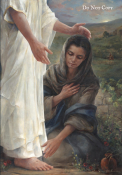
This painting testifies of the Living Christ and reflects the Savior's example of ministering one-by-one. The artist's interpretation of Matthew 28, it depicts Joanna, (wife of Herod's steward, Chuza), one of the devoted Galilean women to whom the Resurrected Christ appeared on Easter morning (see Matthew 28:8-9, Mark 16:1, Luke 24:2-10).
The painting's lighting celebrates the Savior as the Light of the world: He is the brightest element in the painting, and His light illuminates His immediate surroundings. Christ's hands are tenderly outstretched to Joanna, as they are to all. In turn, the woman reverently reaches toward the wound in her Master's feet while gently clasping her heart in awe of His great sacrifice.
By isolating 'the one' and by selecting a partial view of Christ's figure focusing on the sacred tokens of His sacrifice rather than on His face and features, the painting's simple composition is intended to invite viewers to contemplate their own unique relationship to the Savior as a recipient of His Atonement.
The painting's lighting celebrates the Savior as the Light of the world: He is the brightest element in the painting, and His light illuminates His immediate surroundings. Christ's hands are tenderly outstretched to Joanna, as they are to all. In turn, the woman reverently reaches toward the wound in her Master's feet while gently clasping her heart in awe of His great sacrifice.
By isolating 'the one' and by selecting a partial view of Christ's figure focusing on the sacred tokens of His sacrifice rather than on His face and features, the painting's simple composition is intended to invite viewers to contemplate their own unique relationship to the Savior as a recipient of His Atonement.
Symbolism in O Divine Redeemer
The Redeemer is clothed in a simple white robe or garment such as is described in 3 Nephi 11. The gold edging of the Savior's traditional Palestinian-style caftan is a nod to descriptions by John the Revelator and the prophet Daniel who each describe the Savior's resurrected clothing as containing gold (see Revelation 1:13 and Daniel 10:5).
Joanna wears a traditional long-sleeved linen thobe and head-wrap typical of believing women in the Savior's day. As depicted, these garments were often left undyed. Since ancient times, cloth or embroidery dyed blue has been used by Galilean women to indicate mourning. It is used here as a reminder of the Savior's miraculous power to turn mourning to joy (Isaiah 61:3).
In the absence of detail from the Gospel narratives regarding the precise location of the Savior's appearance to the women on their way to Jerusalem to share the glad tidings, the setting in which the figures are painted is not intended to identify with any one particular spot but, instead, is inspired by the historical descriptions of Jerusalem's surrounding countryside. All terrain, stone-work, flora, and other detailing are appropriate to Jerusalem, the Valley Kidron, and other nearby waysides.
Consistent with the Gospel narrative, the distant horizon suggests the hours of dawn. A winding path in the distance connects with the paths and stone walls which lead the viewer's eyes toward the painting's focal point. In the near distance, the viewer sees a small Palestinian boy astride a donkey whose gaze is turned back toward the Master. These roads and the boy are intended to represent all on their journey through mortality and the imperative to turn and "look to Christ and live" (Alma 38:47).
The Savior's sacrifice and Resurrection occurred during the early Spring in the month known in the Holy Land as "the month of flowering." Accordingly, the figures are surrounded by blooms native to the hillsides of Jerusalem, Kidron, and the surrounding countryside. The following species have particular meaning. Grapevine (Vitis vinifera) trailing over a stone wall behind the figures reminds viewers of the Savior's teachings to His disciples during the Last Supper: "I am the true vine, and my Father is the husbandman" (John 15:1). Poppy anemones (Anemone coronaria) are believed by many to be the "lilies of the field" (Matthew 6:28) from Christ's Sermon on the Mount and are intended to symbolize His tender watchcare. For some today, this small blood-red flower also symbolizes martyrdom. Wild mustard (Brassica nigra) painted immediately in front and behind Joanna's figure is intended to remind the viewer of the faith described in the Savior's parable of the mustard seed. Sage (Salvia palestina) has long been a symbol of wisdom and could remind viewers of the Savior's testimony that, "a greater than Solomon is here" (see Matthew 12:42 and Luke 11:31).
The embalming oils Joanna and her fellow disciples brought with them to the tomb were often kept in ceramics like the one painted in the lower right corner of the painting. A reminder of Joanna's compassionate ministering, this juglet could also remind viewers of the prophetic promise that all who, "mourn in Zion, to give unto them beauty for ashes, the oil of joy for mourning" (Isaiah 61:3).
Stone appears throughout the painting's composition—an edifice in the distance, rock walls in both midground and foreground, and a flagstone path on which the Savior stands. All these are intended to remind the viewer of the "Rock of Heaven" (Moses 7:53) and the "Rock of our Redeemer" (Helaman 5:12), Himself. Additionally, the rock also has reference to God's power delegated to man (see Matthew 16:18).
Joanna wears a traditional long-sleeved linen thobe and head-wrap typical of believing women in the Savior's day. As depicted, these garments were often left undyed. Since ancient times, cloth or embroidery dyed blue has been used by Galilean women to indicate mourning. It is used here as a reminder of the Savior's miraculous power to turn mourning to joy (Isaiah 61:3).
In the absence of detail from the Gospel narratives regarding the precise location of the Savior's appearance to the women on their way to Jerusalem to share the glad tidings, the setting in which the figures are painted is not intended to identify with any one particular spot but, instead, is inspired by the historical descriptions of Jerusalem's surrounding countryside. All terrain, stone-work, flora, and other detailing are appropriate to Jerusalem, the Valley Kidron, and other nearby waysides.
Consistent with the Gospel narrative, the distant horizon suggests the hours of dawn. A winding path in the distance connects with the paths and stone walls which lead the viewer's eyes toward the painting's focal point. In the near distance, the viewer sees a small Palestinian boy astride a donkey whose gaze is turned back toward the Master. These roads and the boy are intended to represent all on their journey through mortality and the imperative to turn and "look to Christ and live" (Alma 38:47).
The Savior's sacrifice and Resurrection occurred during the early Spring in the month known in the Holy Land as "the month of flowering." Accordingly, the figures are surrounded by blooms native to the hillsides of Jerusalem, Kidron, and the surrounding countryside. The following species have particular meaning. Grapevine (Vitis vinifera) trailing over a stone wall behind the figures reminds viewers of the Savior's teachings to His disciples during the Last Supper: "I am the true vine, and my Father is the husbandman" (John 15:1). Poppy anemones (Anemone coronaria) are believed by many to be the "lilies of the field" (Matthew 6:28) from Christ's Sermon on the Mount and are intended to symbolize His tender watchcare. For some today, this small blood-red flower also symbolizes martyrdom. Wild mustard (Brassica nigra) painted immediately in front and behind Joanna's figure is intended to remind the viewer of the faith described in the Savior's parable of the mustard seed. Sage (Salvia palestina) has long been a symbol of wisdom and could remind viewers of the Savior's testimony that, "a greater than Solomon is here" (see Matthew 12:42 and Luke 11:31).
The embalming oils Joanna and her fellow disciples brought with them to the tomb were often kept in ceramics like the one painted in the lower right corner of the painting. A reminder of Joanna's compassionate ministering, this juglet could also remind viewers of the prophetic promise that all who, "mourn in Zion, to give unto them beauty for ashes, the oil of joy for mourning" (Isaiah 61:3).
Stone appears throughout the painting's composition—an edifice in the distance, rock walls in both midground and foreground, and a flagstone path on which the Savior stands. All these are intended to remind the viewer of the "Rock of Heaven" (Moses 7:53) and the "Rock of our Redeemer" (Helaman 5:12), Himself. Additionally, the rock also has reference to God's power delegated to man (see Matthew 16:18).
Copyright and terms of use
© By Intellectual Reserve, Inc. You may not print, copy, or reproduce this artwork or make derivative works from it without the prior written consent of the copyright holder. Al Young Studios cannot make or sell any prints of this artwork at this time. Read more...From the Newsroom
By Al R. Young O Divine Redeemer is the newest oil painting to be added to the line of original artworks from Al Young Studios.
Click here to see a larger image of the new painting, read the artist's commentary, and look at the selection of prints--if any are available.... Read more »
Tags: O Divine Redeemer, 2026, Elspeth C. Young, Legacy, News, Oil paintings and prints, The Messiah Art Collection, Women of the Bible Art Collection