“Fresh Courage Take”
{ Ellen Sanders Kimball }
Painted by Elspeth Young
« Previous Painting • Next Painting »
Al Young Studios cannot make or sell any prints of this work at this time. Read more...3 Nephi 18:24
Therefore, hold up your light that it may shine unto the world. Behold I am the light which ye shall hold up—that which ye have seen me do.
The story behind Fresh Courage Take
In this painting, 26-year-old Ellen Sanders Kimball, wife of Heber C. Kimball and a nurse in the Vanguard Company of saints that had been commissioned to blaze a trail to the Saints' new home in the Rocky Mountains, lifts her lantern light before the early sunrise of July 20, 1847. She is standing at "Heartbreak Ridge" (Pratt's Pass near present-day Henefer, Utah) —so named because it was the Company's first glimpse of what would constitute the most dangerous and demanding leg of their thousand-mile trek from Winter Quarters—the Wasatch Range and Emigration Canyon.
The wagons flanking her are among the 15 wagons and 30 other saints that had departed their campsite near the Weber River at 4:30 that morning so that those still suffering the effects of Colorado Tick Fever could travel during the coolest part of the day. The remaining 130 individuals and 62 wagons comprising both the advance party and main company of the Vanguard were one to two days ahead. Only two days before, Brigham Young was so ill that it had been feared he might not live to do more than look from a distance upon the mountains that would become the Saints' new home.
At this moment in her journey, perhaps Ellen needed "fresh courage" more than ever, being newly expectant and exhausted from weeks of providing continual care in the wake of the tick fever that plagued the entire Company. She wrote: "It seemed as if the hardest part of our journey was before us, and it was—for no one can conceive of the hard work it took to get our company through Emigration Canyon to the Valley." Notwithstanding the difficulties, however, she hoped and traveled on, and, despite the desolate prospect once the Valley was reached four days later, her courage did not fail. Her fellow Vanguard traveler, Clarissa Decker Young, eulogized Ellen as, "a resourceful woman, and in all the trying times that followed the settling of the wilderness, she was a tower of strength to all who came within the field of her influence."
Accordingly, the viewer sees Ellen at this moment of greatest discouragement faithfully holding her light aloft—itself a symbol of Christ (see 3 Nephi 18:35) and "the fire of the covenant made in the house of the Lord" (Brigham Young quoted in "Journal History of The Church of Jesus Christ of Latter-day Saints," 28 Sept. 1846).
Beyond her in the distance, however, the viewer sees that, despite her challenges, she is not alone. The wagon train she follows is seen led by the carriage carrying the Prophet. Symbolically, its headlamp lights the way into the darkest uncertainty in the painting—just like prophetic counsel dispels error and fear. Courageously continuing "in the path of [her] duty," Ellen is in line behind the Prophet, ready to follow where he directs and, together with her fellow companions, we see her surrounded by the assurance of the stars in the firmament above her head and the approach of dawn—both Heavenly guides which herald "fresh courage" for every day ahead.
In tribute both to her unique contribution to the creation of the hymn "Come, Come Ye Saints," as well as her fortitude carrying on in the light of Christ despite taxing and unforeseeable hardships, this painting is named for the "fresh courage" Ellen's life of faith and sacrifice inspired in all who knew her. In 1846 during the dark days of Winter Quarters, when Ellen's friend and fellow Vanguard traveler, William Clayton, penned "Come, Come Ye Saints" including the stirring reassurance "Gird up your loins/ Fresh courage take/ Our God will never us forsake," it was in direct response to joyful news that Ellen shared with William: the message that despite the severe illnesses and privations William's wife, Diantha, was then suffering, Diantha had safely delivered a healthy baby boy.
Born Aagaat Ellen Ostensdatter, Ellen Sanders Kimball (1823-1871) emigrated to the United States from Telemark, Norway when she was thirteen years old. In her early twenties while working in Illinois, she first heard the message of The Church of Jesus Christ of Latter-day Saints and was baptized a member in 1842. She joined with the saints in Nauvoo in 1844, at which time she accepted the hand of Heber C. Kimball (1801-1868) in marriage.
Together with Clarissa Decker Young (1828-1889) and Harriet Wheeler Young (1803-1871), Ellen was one of only three women who set out from Winter Quarters to trailblaze the wilderness. Elizabeth Brown Crow (1795-1870), Harriet Brunt Crow (1830-1903), Elizabeth Jane Crow (1838-unknown), Ira Minda Crow (1833-1851), Isa Vinda Crow (1833-1851), and Matilda Jane Crow Threlkel (1825-1906) of the Mississippi Company joined with the Vanguard in Wyoming, making Ellen one of eight women who were first to set foot in the Valley of the Great Salt Lake.
The wagons flanking her are among the 15 wagons and 30 other saints that had departed their campsite near the Weber River at 4:30 that morning so that those still suffering the effects of Colorado Tick Fever could travel during the coolest part of the day. The remaining 130 individuals and 62 wagons comprising both the advance party and main company of the Vanguard were one to two days ahead. Only two days before, Brigham Young was so ill that it had been feared he might not live to do more than look from a distance upon the mountains that would become the Saints' new home.
At this moment in her journey, perhaps Ellen needed "fresh courage" more than ever, being newly expectant and exhausted from weeks of providing continual care in the wake of the tick fever that plagued the entire Company. She wrote: "It seemed as if the hardest part of our journey was before us, and it was—for no one can conceive of the hard work it took to get our company through Emigration Canyon to the Valley." Notwithstanding the difficulties, however, she hoped and traveled on, and, despite the desolate prospect once the Valley was reached four days later, her courage did not fail. Her fellow Vanguard traveler, Clarissa Decker Young, eulogized Ellen as, "a resourceful woman, and in all the trying times that followed the settling of the wilderness, she was a tower of strength to all who came within the field of her influence."
Accordingly, the viewer sees Ellen at this moment of greatest discouragement faithfully holding her light aloft—itself a symbol of Christ (see 3 Nephi 18:35) and "the fire of the covenant made in the house of the Lord" (Brigham Young quoted in "Journal History of The Church of Jesus Christ of Latter-day Saints," 28 Sept. 1846).
Beyond her in the distance, however, the viewer sees that, despite her challenges, she is not alone. The wagon train she follows is seen led by the carriage carrying the Prophet. Symbolically, its headlamp lights the way into the darkest uncertainty in the painting—just like prophetic counsel dispels error and fear. Courageously continuing "in the path of [her] duty," Ellen is in line behind the Prophet, ready to follow where he directs and, together with her fellow companions, we see her surrounded by the assurance of the stars in the firmament above her head and the approach of dawn—both Heavenly guides which herald "fresh courage" for every day ahead.
In tribute both to her unique contribution to the creation of the hymn "Come, Come Ye Saints," as well as her fortitude carrying on in the light of Christ despite taxing and unforeseeable hardships, this painting is named for the "fresh courage" Ellen's life of faith and sacrifice inspired in all who knew her. In 1846 during the dark days of Winter Quarters, when Ellen's friend and fellow Vanguard traveler, William Clayton, penned "Come, Come Ye Saints" including the stirring reassurance "Gird up your loins/ Fresh courage take/ Our God will never us forsake," it was in direct response to joyful news that Ellen shared with William: the message that despite the severe illnesses and privations William's wife, Diantha, was then suffering, Diantha had safely delivered a healthy baby boy.
Born Aagaat Ellen Ostensdatter, Ellen Sanders Kimball (1823-1871) emigrated to the United States from Telemark, Norway when she was thirteen years old. In her early twenties while working in Illinois, she first heard the message of The Church of Jesus Christ of Latter-day Saints and was baptized a member in 1842. She joined with the saints in Nauvoo in 1844, at which time she accepted the hand of Heber C. Kimball (1801-1868) in marriage.
Together with Clarissa Decker Young (1828-1889) and Harriet Wheeler Young (1803-1871), Ellen was one of only three women who set out from Winter Quarters to trailblaze the wilderness. Elizabeth Brown Crow (1795-1870), Harriet Brunt Crow (1830-1903), Elizabeth Jane Crow (1838-unknown), Ira Minda Crow (1833-1851), Isa Vinda Crow (1833-1851), and Matilda Jane Crow Threlkel (1825-1906) of the Mississippi Company joined with the Vanguard in Wyoming, making Ellen one of eight women who were first to set foot in the Valley of the Great Salt Lake.
Symbolism in Fresh Courage Take
Ellen was described by her contemporaries as, "of medium size. Her complexion was very fair, like other [Norwegian] country women, with good color, rosy cheeked, and an abundance of light hair...wholesome and good looking." Ellen's costume is a combination of elements frequently worn by women travelers on the plains—together with elements reminiscent of her native Norway, including the coronet braids woven through the typical Victorian hairstyle of her era. Her nurse's style bib-apron covers a simple mid-length prairie dress of cut and dye typical of her era.
Tucked over her shoulders and pinned at the waist is a practical woolen knitted sjal (shawl) often worn by women in Telemark, which could have protected her from the frigid morning temperatures in the Rockies. Her knitted woolen stockings are also Norwegian style and dye, while her laced black leathern shoes are characteristic of mid-century American footwear such as cobblers manufactured in Nauvoo. The lantern in her hand is a period-accurate, sconce-style lantern lit by candle, and the underwing night moths (Catocala aholibah) drawn to its light are native to Morgan County, Utah.
Retrievers, hounds, and pointers were a common companion to emigrants along the trek West, and Vanguard diarists note 17 dogs who accompanied them during their journey. American foxhounds, like the one depicted as protecting Ellen, were introduced into the United States in the 17th century and are frequently mentioned in nineteenth-century depictions of wagon trains during the westward migration.
Covered farm-style wagons were the most common wagon style used on the Overland Trail from Winter Quarters to Salt Lake. All such conveyances used by mid-century travelers in the Western migration were bespoke and, therefore, as unique as the individuals who traveled in them. Those taken by the Vanguard Company of 1847 were primarily hand-made by carpenters, cabinet-makers, wheelwrights, and blacksmiths during the winter of 1845.
Irregularities and idiosyncrasies in structure distinguish hand-hewn wagons from the machine-made wagons of post-Industrial eras. Accordingly, the artist has been careful to preserve a sense of hand-hewn construction in her painting to lend a feeling of authenticity.
The wagons depicted here are also smaller in scale than freight or family wagons typical of later wagon companies, befitting the Vanguard's trail-blazing mission.
As depicted within this painting, such wagons typically had amber-hued oil cloth canvas bonnets strapped to hickory or oaken bows with leathern cording or rope. These canvas covers were often lined with thick mackinaw or other wool as additional protection against the elements. Their square or bow-boxed pine wagons beds were most often painted "Colonial" (steel) blue or hunter green, while wheels and axel trees were painted with red iron oxide. The wheels' outer tires were made of iron and were reset by the Vanguard blacksmiths frequently throughout their trek.
Heber and Ellen took six wagons and carriages with them when they departed Winter Quarters for the Salt Lake Valley April 14, 1847. During the last weeks of the trek, three of these were sent ahead with the Main Company, and three remained behind with Heber, Ellen, and the rear guard. Two of these latter three wagons are represented in this artwork.
The wagon to Ellen's left contains items symbolic of her unique contributions and ministering efforts within the Vanguard. Tin cooking utensils, buckets, and flour sacks together with dried wild onion roots gathered by the wayside all remind the viewer of her work providing meals for the Vanguard. Equally symbolic is the patchwork quilt—an irreplaceable part of the Westward migration symbolizing birth, death, and women's efforts to beautify the wilderness. Its fabrics are period accurate, and the pattern ("Grandmother's Garden") was popularized in America in the 1830s. The ladder-back chair and ticking bolster typical of the era are also a reminder of the work of making a home in the wilderness.
The wagon to Ellen's right (with the traditional canvas tent roll and feller's axe strapped to its wagon bed) is symbolic of the work and industry needed to blaze the Overland Trail. Its steel-gray wagon bed echoes the color of the only known extant wagon believed to have traveled with the Vanguard Company.
Brigham's brother, Lorenzo Young, and his wife, Harriet Decker Young, accompanied Ellen in the rear guard. Harriet carried chickens on the back of her wagon in a coop specially made for the purpose. The viewer can also see Lorenzo guiding his team of Red Durham oxen through the turn.
Brigham's wife, Clarissa, also travelled in the rear guard. Within the painting, the wagon driven by mule team is intended to represent hers. Consistent with the practice of Vanguard pioneers, horse and mule teams preceded any oxen-drawn wagons so that the sturdier-footed animals could trample the new road prior to the tender-footed oxen. It was also common practice for the Vanguard trains to travel single-file except in times of danger.
Wilford Woodruff escorted Brigham Young and Albert Rockwood (who were both enfeebled by tick fever at this stage of the journey) in his private carriage--"the most comfortable [conveyance] of the company"--the morning of July 20, 1847. Significantly, this same carriage was the conveyance in which Brigham Young received the spiritual witness that the Vanguard had found the future home of the saints.
Carriages were not an uncommon sight during the Westward migration and are often mentioned by mid-century diarists travelling the plains, including those of the Vanguard.
Piecing together Wilford's descriptions of his carriage throughout his 1847 diary (together with careful study of paintings of mid-century pioneer artists' depictions from C. C. A. Christensen and John C. Hafen) the artist, under the direction of experts, selected a 'quarter-curtained Rockaway' to represent the carriage in which the Prophet rode that day and during the remainder of his journey to the Valley.
Fellow rear-guard traveler, Howard Egan, often stood guard over Ellen, Clarissa, and Harriet during their journey West. Howard also regularly helped Ellen in the mess. He is the horseman depicted pausing in his morning's ride to the outside of the train.
The snow-capped Wasatch Mountain Range is visible in the painting as viewed from the Pratt's Pass lookout. Vanguard diarists indicate frequent thunderstorms and chilly mountain nights and early mornings during this week of their travels, with extremely cold temperatures in the hours before the rear guard's departure July 20th. Accordingly, the artist depicted a cloudy sky punctuated by patches of calm where the firmament is still reassuringly visible. The patterns of stars are based on those visible near the mountain ranges in Morgan County at this time of day and year.
As they forged their way through Pratt's Pass, Vanguard diarists remarked an abundance of grasses and Artemsia, of which the patches of Kentucky bluegrass (Poa pratensis), Indian ricegrass (oryzoposis hymenoides), Silver (Artemesia cana) and Fringed sagebrush (Artemesia frigide) varieties are all native to Morgan County. The area's rough and rocky terrain is also indicated in the painting's foreground.
Mentions of wild rose in full bloom (of which the mountain rose (Rosa woodsii) is native) are also mentioned during this phase of the Vanguard's journey, and the viewer sees a blossom plucked from low-growing wayside roses held in Ellen's hand, as well as the low-growing branch from which it has been plucked. These blossoms are intended to remind the viewer that, "The pioneers turned their wilderness into a fruitful field and made the desert blossom as a rose—precisely as prophesied by Isaiah centuries before (see Isaiah 32:15–16, 35:1). Upon our shoulders lies the responsibility to keep the faith through our own generation. This "ball" is in our court!" (Nelson, Russell M., The Exodus Repeated, September 7, 1997). Symbolically, the rose is depicted immediately in the viewer's space as a reminder that we stand where the Vanguard once stood, enjoying the blessings of their sacrifices.
Initial research for this painting was performed by the artist under advisement from Vanguard scholar specialists at the Church History Department of The Church of Jesus Christ of Latter-day Saints, with whom the artist met and corresponded during the summer of 2022--at which time the artist began original research specific to this painting which research lasted into the summer of 2024. Special Thanks to Dennis Lyman, This Is The Place Heritage Park and History of the Saints project; Brett Dowdle, researcher Joseph Smith Papers; and Carrie Snow, registrar Museum of Church History and Art.
The material provided in this narrative is the original research of the artist gathered from the first-hand records of members of Brigham Young's 1847 Vanguard Company including the diaries of Heber C. Kimball, Wilford Woodruff, Parley P. Pratt, Howard Egan, Norton Jacobs, William Clayton, Erastus Snow, Albert Rockwood, Thomas Bullock, Levi Jackman, Lorenzo Young, Amasa Lyman, and others. The artist also studied the diaries of other 1840s travelers in the Westward migration whose trailblazing echo the efforts, challenges, and hardships encountered by Brigham Young's company (and who, themselves, refer to their observations of those traveling the Overland Trail). In instances where primary sources were ambiguous, the artist worked under the direction of research specialists in the Church History Department as well as other specialists in material culture and manners and customs of the Westward migration, supplemented by reliable secondary sources.
"American Foxhound: About the Breed" https://www.akc.org/dog-breeds/american-foxhound/.
Berkebile, Donald H., Carriage Terminology, Smithsonian 1978.
Carlisle, Lilian Baker, The Carriages at Shelburne Museum, 1956.
Day by Day with the Utah Pioneers 1847 - A Chronological Record of the Trek Across the Plains, 1927.
Ellen Kimball; database and images, Ancestry.com (http://ancestry.com, accessed Nov. 2014
First Encampment Park Historical Marker 3 Placed by: Daughters of the Utah Pioneers
Gardner, Mark L., Wagons on the Santa Fe Trail 1822-1880, National Park Service, 1997.
Gregg, Josiah, Commerce of the Prairies, ed. Max L. Moorhead (Norman: University of Oklahoma Press, 1954), p. 27.
Hancey, Helen Louise. A Naturalistic Study of the History of Mormon Quilts and their Influence on Today's Quilters, Theses and Dissertation, Brigham Young University Scholars Archives, 1996.
History of the Church, Vol. 7, p. 535.
Hogsback Summit, 2004-10, BYU Digital Special Collections.
Jakeman, Ellen. "The Lady Pioneers", Woman's Exponent, (15 September 1890), Page 3.
Meller, Susan and Joost Effers,Textile Designs Two Hundred Years of European and American Patterns Organized by Motifs, Style, Color, Layout, and Period: Harry M. Abrams Inc., 1991.
Online Museum database for Norsk Institutt for bunad og folkedrakt.
"Oxen: Engines of the Overland Emigration" by Dixon Ford and Dandlee Kreutzer (published in Overland Journal Vol. 33 No.1, 2015).
Roberts, B. H., A Comprehensive History of The Church of Jesus Christ of Latter-day Saints (Vol. 3), Brigham Young University Press, 1965
Kimball, Ellen Sanders (attr.): undated typescript (https://www.familysearch.org/tree/person/memories/KWV9-HFZ).
Smith, Linda H., A History of Morgan County published by Utah State Historical Society, 1999.
Transcript for Heber C. Kimball journal in Heber C. Kimball papers, 1837-1866.
Transcript for Thomas Bullock journals, 1843-1849, Journal, 1847 April-June.
Transcript for Pioneering the West, 1846 to 1878: Major Howard Egan's Diary, edited and compiled by William M. Egan (1917), 21-105.
Transcript for Wilford Woodruff journal, 1847 January-1853 December, 25-77.
Transcript for William Clayton diaries, 1846-1853, Folder contents: (2) Volume 2, 1847.
Utah Historical Quarterly Volume 14 No 1-4 1946, p. 174 (footnote)
"Utah's Three Pioneer Women," Deseret News, Oct. 1, 1901, 11. https://www.churchhistorianspress.org/the-first-fifty-years-of-relief-society/people/ellen-sanders-kimball?lang=eng
Videos from Engels' Coach Shop (Joliet Montana).
Videos from Hansen Wheel and Wagon Shop (Letcher, South Dakota).
Wells, Emeline B. "Ellen Sanders Kimball," rough draft typescript, "DUP" files, undated.
William Clayton, April 15, 1846 (p. 44 in Folder contents: (1) Volume 1, 1846 January-November.
Tucked over her shoulders and pinned at the waist is a practical woolen knitted sjal (shawl) often worn by women in Telemark, which could have protected her from the frigid morning temperatures in the Rockies. Her knitted woolen stockings are also Norwegian style and dye, while her laced black leathern shoes are characteristic of mid-century American footwear such as cobblers manufactured in Nauvoo. The lantern in her hand is a period-accurate, sconce-style lantern lit by candle, and the underwing night moths (Catocala aholibah) drawn to its light are native to Morgan County, Utah.
Retrievers, hounds, and pointers were a common companion to emigrants along the trek West, and Vanguard diarists note 17 dogs who accompanied them during their journey. American foxhounds, like the one depicted as protecting Ellen, were introduced into the United States in the 17th century and are frequently mentioned in nineteenth-century depictions of wagon trains during the westward migration.
Covered farm-style wagons were the most common wagon style used on the Overland Trail from Winter Quarters to Salt Lake. All such conveyances used by mid-century travelers in the Western migration were bespoke and, therefore, as unique as the individuals who traveled in them. Those taken by the Vanguard Company of 1847 were primarily hand-made by carpenters, cabinet-makers, wheelwrights, and blacksmiths during the winter of 1845.
Irregularities and idiosyncrasies in structure distinguish hand-hewn wagons from the machine-made wagons of post-Industrial eras. Accordingly, the artist has been careful to preserve a sense of hand-hewn construction in her painting to lend a feeling of authenticity.
The wagons depicted here are also smaller in scale than freight or family wagons typical of later wagon companies, befitting the Vanguard's trail-blazing mission.
As depicted within this painting, such wagons typically had amber-hued oil cloth canvas bonnets strapped to hickory or oaken bows with leathern cording or rope. These canvas covers were often lined with thick mackinaw or other wool as additional protection against the elements. Their square or bow-boxed pine wagons beds were most often painted "Colonial" (steel) blue or hunter green, while wheels and axel trees were painted with red iron oxide. The wheels' outer tires were made of iron and were reset by the Vanguard blacksmiths frequently throughout their trek.
Heber and Ellen took six wagons and carriages with them when they departed Winter Quarters for the Salt Lake Valley April 14, 1847. During the last weeks of the trek, three of these were sent ahead with the Main Company, and three remained behind with Heber, Ellen, and the rear guard. Two of these latter three wagons are represented in this artwork.
The wagon to Ellen's left contains items symbolic of her unique contributions and ministering efforts within the Vanguard. Tin cooking utensils, buckets, and flour sacks together with dried wild onion roots gathered by the wayside all remind the viewer of her work providing meals for the Vanguard. Equally symbolic is the patchwork quilt—an irreplaceable part of the Westward migration symbolizing birth, death, and women's efforts to beautify the wilderness. Its fabrics are period accurate, and the pattern ("Grandmother's Garden") was popularized in America in the 1830s. The ladder-back chair and ticking bolster typical of the era are also a reminder of the work of making a home in the wilderness.
The wagon to Ellen's right (with the traditional canvas tent roll and feller's axe strapped to its wagon bed) is symbolic of the work and industry needed to blaze the Overland Trail. Its steel-gray wagon bed echoes the color of the only known extant wagon believed to have traveled with the Vanguard Company.
Brigham's brother, Lorenzo Young, and his wife, Harriet Decker Young, accompanied Ellen in the rear guard. Harriet carried chickens on the back of her wagon in a coop specially made for the purpose. The viewer can also see Lorenzo guiding his team of Red Durham oxen through the turn.
Brigham's wife, Clarissa, also travelled in the rear guard. Within the painting, the wagon driven by mule team is intended to represent hers. Consistent with the practice of Vanguard pioneers, horse and mule teams preceded any oxen-drawn wagons so that the sturdier-footed animals could trample the new road prior to the tender-footed oxen. It was also common practice for the Vanguard trains to travel single-file except in times of danger.
Wilford Woodruff escorted Brigham Young and Albert Rockwood (who were both enfeebled by tick fever at this stage of the journey) in his private carriage--"the most comfortable [conveyance] of the company"--the morning of July 20, 1847. Significantly, this same carriage was the conveyance in which Brigham Young received the spiritual witness that the Vanguard had found the future home of the saints.
Carriages were not an uncommon sight during the Westward migration and are often mentioned by mid-century diarists travelling the plains, including those of the Vanguard.
Piecing together Wilford's descriptions of his carriage throughout his 1847 diary (together with careful study of paintings of mid-century pioneer artists' depictions from C. C. A. Christensen and John C. Hafen) the artist, under the direction of experts, selected a 'quarter-curtained Rockaway' to represent the carriage in which the Prophet rode that day and during the remainder of his journey to the Valley.
Fellow rear-guard traveler, Howard Egan, often stood guard over Ellen, Clarissa, and Harriet during their journey West. Howard also regularly helped Ellen in the mess. He is the horseman depicted pausing in his morning's ride to the outside of the train.
The snow-capped Wasatch Mountain Range is visible in the painting as viewed from the Pratt's Pass lookout. Vanguard diarists indicate frequent thunderstorms and chilly mountain nights and early mornings during this week of their travels, with extremely cold temperatures in the hours before the rear guard's departure July 20th. Accordingly, the artist depicted a cloudy sky punctuated by patches of calm where the firmament is still reassuringly visible. The patterns of stars are based on those visible near the mountain ranges in Morgan County at this time of day and year.
As they forged their way through Pratt's Pass, Vanguard diarists remarked an abundance of grasses and Artemsia, of which the patches of Kentucky bluegrass (Poa pratensis), Indian ricegrass (oryzoposis hymenoides), Silver (Artemesia cana) and Fringed sagebrush (Artemesia frigide) varieties are all native to Morgan County. The area's rough and rocky terrain is also indicated in the painting's foreground.
Mentions of wild rose in full bloom (of which the mountain rose (Rosa woodsii) is native) are also mentioned during this phase of the Vanguard's journey, and the viewer sees a blossom plucked from low-growing wayside roses held in Ellen's hand, as well as the low-growing branch from which it has been plucked. These blossoms are intended to remind the viewer that, "The pioneers turned their wilderness into a fruitful field and made the desert blossom as a rose—precisely as prophesied by Isaiah centuries before (see Isaiah 32:15–16, 35:1). Upon our shoulders lies the responsibility to keep the faith through our own generation. This "ball" is in our court!" (Nelson, Russell M., The Exodus Repeated, September 7, 1997). Symbolically, the rose is depicted immediately in the viewer's space as a reminder that we stand where the Vanguard once stood, enjoying the blessings of their sacrifices.
Initial research for this painting was performed by the artist under advisement from Vanguard scholar specialists at the Church History Department of The Church of Jesus Christ of Latter-day Saints, with whom the artist met and corresponded during the summer of 2022--at which time the artist began original research specific to this painting which research lasted into the summer of 2024. Special Thanks to Dennis Lyman, This Is The Place Heritage Park and History of the Saints project; Brett Dowdle, researcher Joseph Smith Papers; and Carrie Snow, registrar Museum of Church History and Art.
The material provided in this narrative is the original research of the artist gathered from the first-hand records of members of Brigham Young's 1847 Vanguard Company including the diaries of Heber C. Kimball, Wilford Woodruff, Parley P. Pratt, Howard Egan, Norton Jacobs, William Clayton, Erastus Snow, Albert Rockwood, Thomas Bullock, Levi Jackman, Lorenzo Young, Amasa Lyman, and others. The artist also studied the diaries of other 1840s travelers in the Westward migration whose trailblazing echo the efforts, challenges, and hardships encountered by Brigham Young's company (and who, themselves, refer to their observations of those traveling the Overland Trail). In instances where primary sources were ambiguous, the artist worked under the direction of research specialists in the Church History Department as well as other specialists in material culture and manners and customs of the Westward migration, supplemented by reliable secondary sources.
"American Foxhound: About the Breed" https://www.akc.org/dog-breeds/american-foxhound/.
Berkebile, Donald H., Carriage Terminology, Smithsonian 1978.
Carlisle, Lilian Baker, The Carriages at Shelburne Museum, 1956.
Day by Day with the Utah Pioneers 1847 - A Chronological Record of the Trek Across the Plains, 1927.
Ellen Kimball; database and images, Ancestry.com (http://ancestry.com, accessed Nov. 2014
First Encampment Park Historical Marker 3 Placed by: Daughters of the Utah Pioneers
Gardner, Mark L., Wagons on the Santa Fe Trail 1822-1880, National Park Service, 1997.
Gregg, Josiah, Commerce of the Prairies, ed. Max L. Moorhead (Norman: University of Oklahoma Press, 1954), p. 27.
Hancey, Helen Louise. A Naturalistic Study of the History of Mormon Quilts and their Influence on Today's Quilters, Theses and Dissertation, Brigham Young University Scholars Archives, 1996.
History of the Church, Vol. 7, p. 535.
Hogsback Summit, 2004-10, BYU Digital Special Collections.
Jakeman, Ellen. "The Lady Pioneers", Woman's Exponent, (15 September 1890), Page 3.
Meller, Susan and Joost Effers,Textile Designs Two Hundred Years of European and American Patterns Organized by Motifs, Style, Color, Layout, and Period: Harry M. Abrams Inc., 1991.
Online Museum database for Norsk Institutt for bunad og folkedrakt.
"Oxen: Engines of the Overland Emigration" by Dixon Ford and Dandlee Kreutzer (published in Overland Journal Vol. 33 No.1, 2015).
Roberts, B. H., A Comprehensive History of The Church of Jesus Christ of Latter-day Saints (Vol. 3), Brigham Young University Press, 1965
Kimball, Ellen Sanders (attr.): undated typescript (https://www.familysearch.org/tree/person/memories/KWV9-HFZ).
Smith, Linda H., A History of Morgan County published by Utah State Historical Society, 1999.
Transcript for Heber C. Kimball journal in Heber C. Kimball papers, 1837-1866.
Transcript for Thomas Bullock journals, 1843-1849, Journal, 1847 April-June.
Transcript for Pioneering the West, 1846 to 1878: Major Howard Egan's Diary, edited and compiled by William M. Egan (1917), 21-105.
Transcript for Wilford Woodruff journal, 1847 January-1853 December, 25-77.
Transcript for William Clayton diaries, 1846-1853, Folder contents: (2) Volume 2, 1847.
Utah Historical Quarterly Volume 14 No 1-4 1946, p. 174 (footnote)
"Utah's Three Pioneer Women," Deseret News, Oct. 1, 1901, 11. https://www.churchhistorianspress.org/the-first-fifty-years-of-relief-society/people/ellen-sanders-kimball?lang=eng
Videos from Engels' Coach Shop (Joliet Montana).
Videos from Hansen Wheel and Wagon Shop (Letcher, South Dakota).
Wells, Emeline B. "Ellen Sanders Kimball," rough draft typescript, "DUP" files, undated.
William Clayton, April 15, 1846 (p. 44 in Folder contents: (1) Volume 1, 1846 January-November.
Copyright and terms of use
© By Intellectual Reserve, Inc. You may not print, copy, or reproduce this artwork or make derivative works from it without the prior written consent of the copyright holder. Al Young Studios cannot make or sell any prints of this artwork at this time. Read more...From the Newsroom
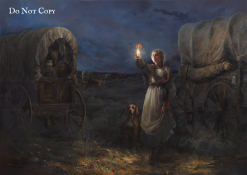
By Al R. Young Fresh Courage Take is the newest oil painting to be added to the line of original artworks from Al Young Studios.
Click here to see a larger image of the new painting, read the artist's commentary, and look at the selection of prints--if any are available.... Read more »
Tags: Fresh Courage Take, 2025, Elspeth C. Young, Legacy, News, Oil paintings and prints, Pioneer Art Collection