The Spirit of the Lord is upon me, because he hath anointed me to preach the gospel to the poor; he hath sent me to heal the brokenhearted, to preach deliverance to the captives, and recovering of sight to the blind, to set at liberty them that are bruised.
The story behind Broken Things to Mend
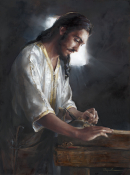
Both Biblical and historic scholarship indicate that the word 'carpenter,' as applied to the Savior's mortal labors in the workshop of His step-father (see Matthew 13:55, Mark 6:3), required expertise as a fashioner of both wood and stone. For the purposes of this painting, however, the artist was inspired by the plaintive plea in George' Blair's poem: "O Carpenter of Nazareth,/This heart, that's broken past repair,/This life, that's shattered nigh to death,/Oh, can You mend them, Carpenter?" coupled with the reassuring refrain: "by His kind and ready hand,/His own sweet life is woven through/Our broken lives, until they stand/A New Creation—'all things new'" (quoted by Jeffrey R. Holland in "Broken Things to Mend," April 2006). Accordingly, the Redeemer is depicted with some of the ancient tools of the carpentry trade--including hand plane, chisel, compass, and marking chalk as described by the Old Testament Prophet, Isaiah (Isaiah 44:13). His work with wood is intended as a reminder of the cross which He carried on behalf of all as well as an expression of His infallible ability to heal every broken heart and soul.
Ancient writings indicate that a carpenter's trade required more than human strength, endurance, and commitment from those who practiced its art, for whom excruciating toil and sleepless nights were typical (see "The Satire of the Trades" quoted on page 44 of "Life in Ancient Egypt" translated by H. M. Tiriah, 1894). While Hebrew carpenters had long been sought, for their honed skills, by the most illustrious world powers, such workman were considered among the lowliest and received only meager remuneration for overwhelming toil. So too, the Savior's unequaled labors through all the night-watches of our lifetimes asks nothing but our whole-hearted obedience in return (see Mosiah 2:20-25).
Ancient writings indicate that a carpenter's trade required more than human strength, endurance, and commitment from those who practiced its art, for whom excruciating toil and sleepless nights were typical (see "The Satire of the Trades" quoted on page 44 of "Life in Ancient Egypt" translated by H. M. Tiriah, 1894). While Hebrew carpenters had long been sought, for their honed skills, by the most illustrious world powers, such workman were considered among the lowliest and received only meager remuneration for overwhelming toil. So too, the Savior's unequaled labors through all the night-watches of our lifetimes asks nothing but our whole-hearted obedience in return (see Mosiah 2:20-25).
Symbolism in Broken Things to Mend
The unadorned and confined space in which the Savior works is symbolic of the power and purpose of His mission to "preach the gospel to the poor ... to heal the brokenhearted, to preach deliverance to the captives ... to set at liberty them that are bruised" (Luke 4:18). This solitary, darkened, even prison-like, space is a symbol of the often narrow and straightened circumstances of our mortality wherein the Savior descended below all grief, sorrow, and sin. He reassures us that we are "graven upon the palms of [His] hands" and that our "walls are continually before [Him]" (Isaiah 49:16). But just as the light outside the window is bursting through the darkness, so too the Savior's light penetrates even the depths of Hell (see Psalms 139:8). Just as He is the light amid darkness in this painting, His "perfect love casteth out fear" (1 John 4:18).
The Savior's figure is itself a source of light, symbolic of His role as the light of the world that "shineth in darkness" (John 1:5). His simple workaday caftan and leathern work apron are not only reflective of traditional clothing of the Messiah's day, but a reminder of the His active role in our lives. "Dressed for action" (see ESV Luke 12:35), the Savior is ready and willing to mend our lives. With one hand, he clasps an ancient ram's-horn carpenter's plane (itself a symbol of His role as the Anointed One), while with His other hand He tenderly pauses to touch the wood being worked to judge its soundness and perfection. The latter symbolizes His purifying, tender touch in our hearts and lives as we allow Him to mend the breaks and cracks and crevices in our character and circumstances. Together, they are a reminder of the Apostolic promise: "You can heal, and you can trust that with the power and grace of Jesus Christ, you will overcome and conquer. Jesus specializes in the seemingly impossible. He came here to make the impossible possible, the irredeemable redeemable, to heal the unhealable, to right the unrightable, to promise the unpromisable. And He's really good at it. In fact, He's perfect at it" (Patrick Kearon, "He Is Risen with Healing in His Wings: We Can Be More than Conquerors," April 2022).
The Savior's figure is itself a source of light, symbolic of His role as the light of the world that "shineth in darkness" (John 1:5). His simple workaday caftan and leathern work apron are not only reflective of traditional clothing of the Messiah's day, but a reminder of the His active role in our lives. "Dressed for action" (see ESV Luke 12:35), the Savior is ready and willing to mend our lives. With one hand, he clasps an ancient ram's-horn carpenter's plane (itself a symbol of His role as the Anointed One), while with His other hand He tenderly pauses to touch the wood being worked to judge its soundness and perfection. The latter symbolizes His purifying, tender touch in our hearts and lives as we allow Him to mend the breaks and cracks and crevices in our character and circumstances. Together, they are a reminder of the Apostolic promise: "You can heal, and you can trust that with the power and grace of Jesus Christ, you will overcome and conquer. Jesus specializes in the seemingly impossible. He came here to make the impossible possible, the irredeemable redeemable, to heal the unhealable, to right the unrightable, to promise the unpromisable. And He's really good at it. In fact, He's perfect at it" (Patrick Kearon, "He Is Risen with Healing in His Wings: We Can Be More than Conquerors," April 2022).
Copyright and terms of use
© By Elspeth Young, All Rights Reserved. You may not print, copy, or reproduce this artwork or make derivative works from it without the prior written consent of the copyright holder. For permissions, please review our FAQ page.From the Newsroom
By Al R. Young Broken Things to Mend is the newest oil painting to be added to the line of original artworks from Al Young Studios.
Click here to see a larger image of the new painting, read the artist's commentary, and look at the selection of prints--if any are available.... Read more »
Tags: Broken Things to Mend, 2026, Elspeth C. Young, Legacy, News, Oil paintings and prints, The Messiah Art Collection