Now it came to pass that there was a day set apart by the unbelievers, that all those who believed in those traditions should be put to death except the sign should come to pass, which had been given by Samuel the prophet.
Now it came to pass that when Nephi, the son of Nephi, saw this wickedness of his people, his heart was exceedingly sorrowful.
And it came to pass that he went out and bowed himself down upon the earth, and cried mightily to his God in behalf of his people, yea, those who were about to be destroyed because of their faith in the tradition of their fathers.
And it came to pass that he cried mightily unto the Lord all that day; and behold, the voice of the Lord came unto him, saying:Lift up your head and be of good cheer; for behold, the time is at hand, and on this night shall the sign be given, and on the morrow come I into the world, to show unto the world that I will fulfill all that which I have caused to be spoken by the mouth of my holy prophets.
Behold, I come unto my own, to fulfill all things which I have made known unto the children of men from the foundation of the world, and to do the will, both of the Father and of the Son—of the Father because of me, and of the Son because of my flesh. And behold, the time is at hand, and this night shall the sign be given.
And it came to pass that the words which came unto Nephi were fulfilled, according as they had been spoken; for behold, at the going down of the sun there was no darkness; and the people began to be astonished because there was no darkness when the night came.And there were many, who had not believed the words of the prophets, who fell to the earth and became as if they were dead, for they knew that the great plan of destruction which they had laid for those who believed in the words of the prophets had been frustrated; for the sign which had been given was already at hand.
And behold, this will I give unto you for a sign at the time of his coming; for behold, there shall be great lights in heaven, insomuch that in the night before he cometh there shall be no darkness, insomuch that it shall appear unto man as if it was day.
Therefore, there shall be one day and a night and a day, as if it were one day and there were no night; and this shall be unto you for a sign; for ye shall know of the rising of the sun and also of its setting; therefore they shall know of a surety that there shall be two days and a night; nevertheless the night shall not be darkened; and it shall be the night before he is born.
And behold, there shall a new star arise, such an one as ye never have beheld; and this also shall be a sign unto you.
And behold this is not all, there shall be many signs and wonders in heaven.
The story behind At The Going Down Of The Sun
His profoundly remarkable ministry included the following:
- Charged with the sacred records and the leadership of the church shortly before his father disappears. He is left in charge for nine years, apparently with the expectation that his father will still return. His father does not return. (3 Nephi 1:2-3; 2:9)
- Led the faithful during persecutions and threat of annihilation incident to the Savior's birth. (3 Nephi 1:5-23)
- Corrected those who sought to do away with the law of Moses (3 Nephi 1:24-25)
- Ministered as the spiritual leader of the Nephites during the great war with Gadianton robbers, when the Nephites were finally driven into one body where they endured approximately twelve years of warfare and siege, eventually conquering their enemies and eradicating the Gadianton robbers. (3 Nephi 2:11;5:7)
- Just a few years later, Nephi witnessed the fracturing of the church (3 Nephi 6:14); secret slayings of the prophets (3 Nephi 6:23); the re-establishment of a secret society (3 Nephi 6:27-30); the murdering of the chief judge, the dissolution of Nephite government, and the fragmentation of the people into tribes (3 Nephi 7). During this time, Nephi's ministry is described thus by Mormon:
And it came to pass that Nephi—having been visited by angels and also the voice of the Lord, therefore having seen angels, and being eye-witness, and having had power given unto him that he might know concerning the ministry of Christ, and also being eye-witness to their quick return from righteousness unto their wickedness and abominations; therefore, being grieved for the hardness of their hearts and the blindness of their minds—went forth among them in that same year, and began to testify, boldly, repentance and remission of sins through faith on the Lord Jesus Christ.
And he did minister many things unto them; and all of them cannot be written, and a part of them would not suffice, therefore they are not written in this book. And Nephi did minister with power and with great authority.
And it came to pass that they were angry with him, even because he had greater power than they, for it were not possible that they could disbelieve his words, for so great was his faith on the Lord Jesus Christ that angels did minister unto him daily.
And in the name of Jesus did he cast out devils and unclean spirits; and even his brother did he raise from the dead, after he had been stoned and suffered death by the people.
And the people saw it, and did witness of it, and were angry with him because of his power; and he did also do many more miracles, in the sight of the people, in the name of Jesus.
And it came to pass that the thirty and first year did pass away, and there were but few who were converted unto the Lord; but as many as were converted did truly signify unto the people that they had been visited by the power and Spirit of God, which was in Jesus Christ, in whom they believed.
And as many as had devils cast out from them, and were healed of their sicknesses and their infirmities, did truly manifest unto the people that they had been wrought upon by the Spirit of God, and had been healed; and they did show forth signs also and did do some miracles among the people.
Thus passed away the thirty and second year also. And Nephi did cry unto the people in the commencement of the thirty and third year; and he did preach unto them repentance and remission of sins.
Now I would have you to remember also, that there were none who were brought unto repentance who were not baptized with water.
Therefore, there were ordained of Nephi, men unto this ministry, that all such as should come unto them should be baptized with water, and this as a witness and a testimony before God, and unto the people, that they had repented and received a remission of their sins.
And there were many in the commencement of this year that were baptized unto repentance; and thus the more part of the year did pass away.
Nephi endured the cataclysm incident to the Savior's crucifixion, was selected by the Messiah as the chief disciple (3 Nephi 11), and labored among the people.
Nothing is known concerning his death.
Symbolism in At The Going Down Of The Sun
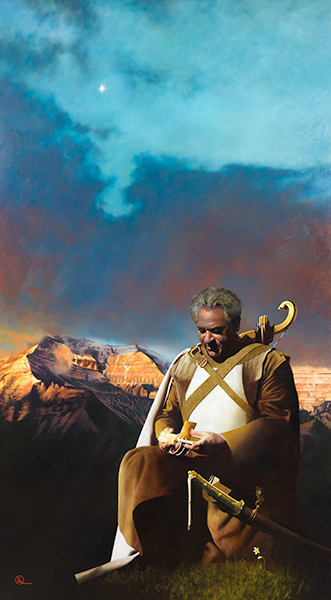
While kneeling in supplication to the Lord, the figure peruses the word of the Lord which he holds in his hands. Nephi's prayer is informed by what the Lord has revealed already. Most of the time, the scriptures contain the answers we seek, but not always, and it is at those times that all our study and contemplation and striving lead us into the mountaintops of life's experience, where there is nowhere to go, but up. That is why the figure appears cradled in the tops of the mountains.
The figure is also dressed for battle. When faced with the specter of annihilation (3 Nephi 1:9), Nephi's prayer might have focused at least in part upon the question of what to do in response to the threat. As recorded in Alma 48:14-16, the Lord had instructed the Nephites "to defend themselves against their enemies, even to the shedding of blood if it were necessary." Moroni's epistle to Pahoran-in which the great champion of his people cited the Lord's declaration "that the inward vessel shall be cleansed first"-had been written not yet 65 years before Nephi and his people also faced destruction. On the other hand, the Ammonites (Alma 24) presented a very different precedent for dealing with such circumstances-a precedent, although 30 years older than Moroni's example, was still relatively recent.
While this is obviously conjectural as far as Nephi is concerned, it likens his predicament to many of the perplexities that bring us to our knees; namely, whether there is something the Lord would have us do to overcome a particular problem, or whether He would have us submit to a period of captivity or even to destruction. Thus, the painting is not simply a painting of Nephi, but a far more general statement about prayer, faith, humility, meekness, and resourcefulness.
The composition itself represents the circumstances surrounding prayer. For example, the rays of a cold sunset bathe the mountain summits at the figure's back. Those snowcapped peaks are the extremity of the mountains' upward reaching toward the silence of the voids between the stars, and, with the setting of the sun, that upward reaching holds on longest to the light of day. But the mountains also reflect the figure's diligence and endurance in mighty prayer. And notwithstanding the height of the mountains, they can never fully reach the stars. Thick darkness also fills the canyons and the valleys all around the kneeling figure, while clouds assail the sky to veil hope.
The lower half of the painting, whence rises not only the darkness in the image but all the striving intent upon surmounting it, is where we think and where we live (see Isaiah 55:8). And yet the Savior, having descended below all things not only answers prayer in ways that shine undimmed above the tumult of the world, but reach up from out the darkness to raise us to a better world.
The star, shimmering high above the figure, is nevertheless behind the figure, representing the fact that we almost always have to look up to understand the answers to our prayers. And, like Nephi, we cannot reach them and hold on to them except by faith.
That fact that more than one light source is evident in the painting suggests not only the phenomena associated with 3 Nephi 1:15, but the light of Heaven that bathes us when we pray.
Windflowers appear at the base of the figure. Today, windflowers are native to much of the Americas; nevertheless, whether the region in which this flower currently exists overlaps with ancient Nephite civilization is immaterial, for the purposes of the Manti Project. What is symbolic is that contemporary scholars believe this genus is a likely candidate for the "lilies of the field" (Matthew 6:28), which the Savior pointed to as evidence of the Father's love and perfect care for His children. Anemone also close their blossoms for the night, and since the flowers in the painting are open or opening—because there is no darkness in the coming night—they represent the devotion of the earth itself at the birth of its Creator.
Copyright and terms of use
© By Al Young, All Rights Reserved. You may not print, copy, or reproduce this artwork or make derivative works from it without the prior written consent of the copyright holder. For permissions, please review our FAQ page.From the Newsroom

By Al R. Young
only high-end custom frames
We have framed our own artworks for more than 30 years, and during that time we have provided a variety of framing services to patrons upon request. For many reasons—including constant changes in the availability of moulding styles—we cannot offer off-the-shelf framing options or response times typically associated with such a service. Of necessity, all of our framing projects are aproached, priced, and billed as constuling projects... Read more »
Tags: Into The West, Spring Rain, North Country, The Grey Havens, Journey's End, Looking Back, Enchanted Stillness, Bedtime Story, In The High Valley, The Daydream, Before The Ball, Old Shannon, Pavane, Sweet Brier, Legend, Mountain Home, And I...
By Al R. Young
content for this page is being prepared and will be added as soon as possible
2021 October 13... Read more »
Tags: At The Going Down Of The Sun, 2021, Oil paintings and prints

By Al R. Young This blank-book journal sells for $32 (plus shipping) direct from Al Young Studios. Printed in full color on heavy paper, the book is bound with black plastic spiral to rest flat when open.
At Home: A Personal Journal features 128 original artworks consisting of 51 original oil paintings from the Artists of Al Young Studios, 44 images from the Studios' Limited Editions Collection, nine pen and ink drawings and block prints by Ashton, seven of Al's exquisitely crafted pencil drawings, and one lithograph from his private portfolios... Read more »
Tags: North Shore, Nasturtium, Wald Kirche, Scabiosa, Foxglove, Narcissus on beige paper, July, Columbine, Maine, Final Draft, Unfurling, Back Shore, Summer's End, Gifts of Morn, Black-eyed Susan, Land's End, Solitude, The Limberlost, Perdita,
By Al R. Young This blank-book journal sells for $32 (plus shipping) direct from Al Young Studios. Printed in full color on heavy paper, the book is bound with black plastic spiral to rest flat when open.
Inspirations features 163 artworks along with 53 commentaries—written by the Artists of Al Young Studios especially for this journal—on such topics as their creative process, the creative environment of the Studios, technical approaches to their artwork, and inspiration from the works of other artists... Read more »
Tags: Untitled, In the Clearing, Anne Girl, Spring Rain, Journey's End, Enchanted Stillness, Bedtime Story, In The High Valley, Mountain Home, And I Will Not Deny The Christ, Sara Crewe, And My Soul Hungered, 3.00.0246.010, The Road To Melek, We...

By Al R. Young December 7th, Al, Ashton, and Elspeth lectured at the Museum of Church History and Art, providing docents with a behind-the-scenes discussion of pieces currently on display in the Christmas exhibit. While they were there, they snapped some pictures of the exhibit in the center gallery.... Read more »
Tags: At The Going Down Of The Sun, Unto The City Of David, According To Thy Word, 2010, Exhibits, News
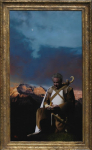
By Al R. Young The annual Christmas exhibit at the Museum of Church History and Art in Salt Lake City includes three paintings by artists at Al Young Studios.
The exhibit, in the Museum's main gallery, is now open to the public (free of charge) and runs through February 2011. Museum hours--Monday through Friday--are 9 a.m. to 9 p.m., and from 10 a.m. to 7 p.m. Saturdays and Sundays. Visit this page of the Museum's web site for its holiday schedule. For information about location and parking, visit this page... Read more »
Tags: At The Going Down Of The Sun, Unto The City Of David, According To Thy Word, 2010, Exhibits, News

By Al R. Young
High-resolution digital copies are available from the Studios for use as illustrations. Use the serial number—appearing below the thumbnail—in requesting permission from the Studios (see links at the bottom of this page for detail).
The correct form of attribution when publishing an image is specified in the license agreement issued to the publisher by Al Young Studios.Guidelines for requests to copy or publish artworks created by the Artists of Al Young Studios
Guidelines for commissioning Al Young Studios to create illustrations
Return to this portfolio
Browse all portfolios
Browse Newsroom articles about Illustration
The original image is available for sale, please contact us for details... Read more »
Tags: At The Going Down Of The Sun, 2010, Book of Mormon characters
By Al R. Young At The Going Down Of The Sun is the newest oil painting to be added to the line of original artworks from Al Young Studios.
Click here to see a larger image of the new painting, read the artist's commentary, and look at the selection of prints--if any are available.... Read more »
Tags: At The Going Down Of The Sun, 2010, Al R. Young, Heroes of the Book of Mormon Art Collection, Legacy, News, Oil paintings and prints, The Messiah Art Collection